The Women Who Made Your Clothes.

A researcher's journey into the lives behind Bangladesh's garment industry
On January 6, 2013, at 6:40 in the morning, I sent an email to my husband. The subject line read: Light of the Day. It said - "At last my thesis work is seeing the light of the day Inshallah. Was awake all night long to finish the work. It is 6:40 in the morning, just finished printing..." He was sleeping in the same room. An awfully stressed and emotionally charged version of me desperately needed a window - to breathe out, to scream in joy and pain and relief, all at once. I did not want to disturb his sleep. So I sent him an email.
He was right there. And I still sent him an email.
My doctoral research carries a big part of who I am today. I started the work when my daughter was nine months old. By the time I submitted, she had grown into a toddler competing with my laptop for my attention. That detail matters. Because the women I was researching - young women leaving their villages in Bangladesh to stitch garments in Dhaka's factories - were also navigating impossible demands. Work. Family. Survival. Their decision to migrate, to work in a factory, to enter a city that didn't know their name - that too was a search for light. Not a steady, reliable light. More like a flicker. A distant city that promised something. Hope and frustration living in the same breath.
What the research was about
Between 2008 and 2013, I conducted a PhD study at the University of Dhaka on women working in Bangladesh's Ready Made Garment (RMG) industry. The PhD was sponsored by a project entitled "Institutionalizing the Department of Women and Gender Studies, University of Dhaka" - funded and intellectually supported by the Institute of Social Studies (ISS), The Hague, the Netherlands. That gave me the privilege of receiving mentorship from Professor Maitrayee Chaudhuri of the Centre for the Study of Social Systems, Jawaharlal Nehru University, New Delhi, and Professor Amrita Chhachhi of the International Institute of Social Studies, The Hague - alongside my PhD supervisor, Professor Amena Mohsin, Department of International Relations, University of Dhaka. A multi-mentorship. I consider it a unique opportunity - to be shaped by multiple scholarly lenses at once.
The RMG industry is massive. It is the backbone of Bangladesh's export economy. And it runs, overwhelmingly, on the labor of poor rural women who migrate from their villages to cities like Dhaka to work long hours for low wages - stitching clothes that end up in stores across the world.
Hundreds of studies have been done on these women. I wanted to take a different path. Go deeper. What made my research stand apart, I believe, is its atypical focus. I wasn't asking simply whether factory work made their lives better or worse - the regular empowerment-indicator questions. I was asking something harder: what does it actually mean for a woman's sense of herself - her identity, her autonomy, her idea of happiness - when she leaves her village, earns her own money, and enters a world her mother never entered? To answer that, I went to the source. A real deep dive. Not just to Dhaka and the factories. I went to the villages these women came from and spent time with their families - in their absence. It was also a comparative study. Not one sending village but two villages - from different parts of Bangladesh. To me, that was a significant point of departure from many other studies.
Two villages. Two completely different stories.
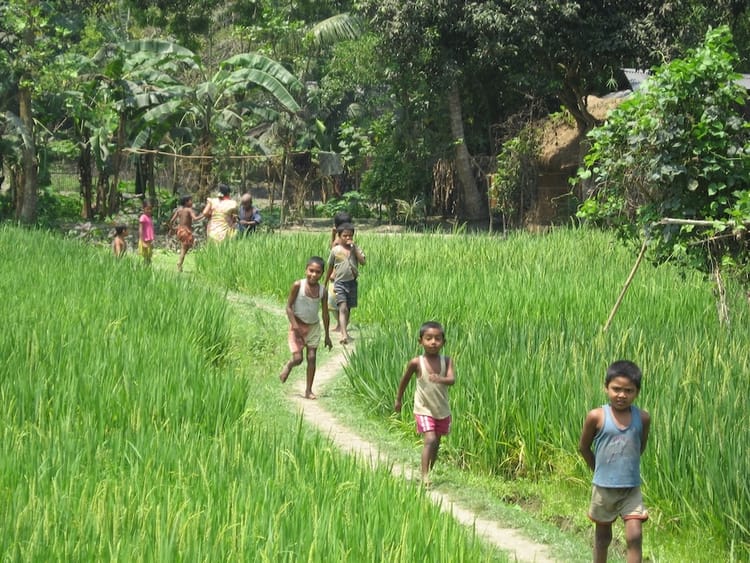
I chose two sending regions - Netrokona, a poor district 122 kilometers from Dhaka, and Khulna, a once-industrial divisional city 322 kilometers away. On paper, both were sending women to the garment factories. In reality, they were worlds apart.
Netrokona sent women to Dhaka in enormous numbers. Khulna, barely at all. Understanding why that difference existed became one of the most revealing threads of the entire study. The answer turned out to involve history, geography, economics, pride, and something that can only be called a community's sense of itself.
My firsthand interactions and conversations with them conveyed messages that no formal interview could capture: a woman's hesitation before answering when asked about her happiness, the way a family fell silent at the question of what would happen if their daughter decided to marry and stop sending money home, the sight of burkha-wearing women boarding a crowded three-wheeler in a remote village in Khulna - navigating public life on their own terms. Each of these was a story in itself.
What I found — in brief
The findings were, as I wrote in the thesis, "a mixed bag." Which is honest.
Factory work gave these women something real. Economic independence, however partial, and an exposure to city life that helped them rediscover their inner strength and resilience. The job gave them bargaining power, albeit sometimes limited, to delay marriage, choose a partner, send money home. For many, working in an RMG factory was the first time in their lives they had money they could call their own.
But empowerment is not a linear concept, nor can one attribute it to a person's life in plain words. It is a negotiation - with family, with community, with one's own ingrained sense of what a woman is supposed to want. The women I met were negotiating constantly. Some were winning ground. Some were exhausted. Some had internalized their own constraints so deeply they didn't experience them as constraints at all.
That complexity came through clearly in the thesis. It is not a victory of globalization, nor is it a simple tale of exploitation. The experience is more than that - it is complex, honest, and nuanced.
What's coming on this site
Over the coming weeks and months, I will publish pieces drawn from this research - rewritten for a general audience, in my own voice. Some will focus on the villages and what the physical landscape of poverty tells us about why people leave. Some will examine what "work" means to a woman whose labor has never been counted or valued. In some posts, I will share stories of individual women - Nasima, Taslima, Amena.
This research was done over a decade ago. A lot has changed since then in Bangladesh and globally. Rana Plaza collapsed in April 2013, just months after I submitted my thesis. That tragedy shook the industry and forced a global conversation that was long overdue. But the questions that my research tried to ask have not gone away. Who makes our clothes? What does it cost them? What do they get in return? What does a woman gain - and give up - when she steps out of her village to work on a factory floor?
Those questions still matter. I still carry them.
This is the first in an occasional series drawn from my PhD research. I will post on different subjects too in between the PhD Series posts. That is the nature of this site. It holds everything I am.


Member discussion