The Missed Call Economy

A village, a phone, and a new language
This is part of an ongoing series drawn from my PhD thesis, "Globalization, Internal Migration and Gender Relations: An Explorative Study on the Women Working at the Ready Made Garment Factories in Dhaka", submitted to the University of Dhaka in 2013. The research was a comparative study of women's migration and work in two different parts of Bangladesh – Netrokona and Khulna. These posts are an effort to share that research experience beyond academic walls.
With this post, I begin sharing the findings from my research. After the heavier theoretical grounding of my previous post, I want to start with something lighter – a small but telling story of how globalization quietly transformed life in one of Bangladesh's most remote villages, one missed call at a time.
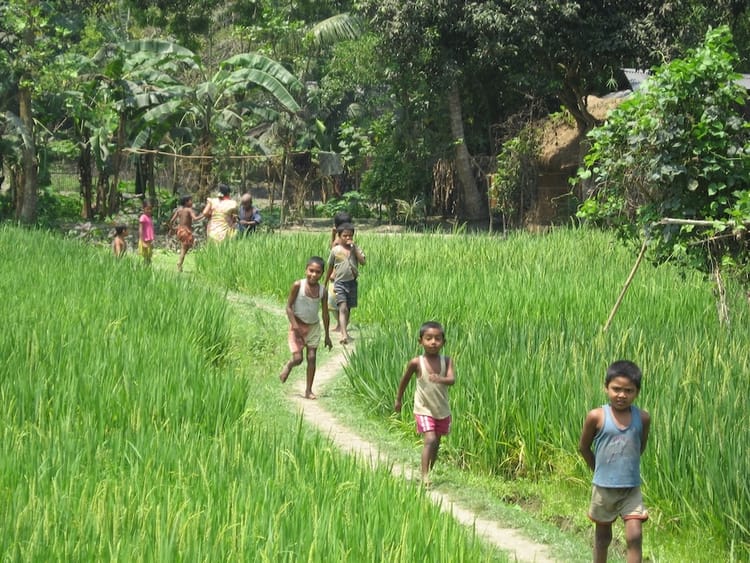
There is a particular image from my fieldwork in Netrokona that has stayed with me. A village without electricity. 95% of the houses are made of mud with thatched roofs – with a few exceptions of one-storey brick houses. It was a village where women working in RMG factories in Dhaka are the primary breadwinners – sending money home to families who depend on that income. It was not a wealthy village by any measure. No reliable electricity. No piped water. A few households faring better than the rest – but most managing on the edge. And yet – in almost every household one thing was common – a mobile phone.
Not always charged. Not always with credit. But it was there.
This is the story of how globalization reached one of Bangladesh's most underdeveloped villages - a small device that nobody planned for but everybody found a way to use.
A village without electricity, with a phone
Though the villagers of Netrokona were not introduced to many technological advancements – no television in most homes, no reliable electricity – almost all households had a cellular phone. This was partly due to another landmark development in Bangladesh – GrameenPhone. Launched in 1997, GrameenPhone's village phone program reached approximately 95 percent of Bangladesh's rural villages. With remarkably lower market prices, the cellular phone became accessible to rural households that would otherwise never have had one. Coupled with RMG work, the cellular phone became an indispensable necessity – a bridge across the geographical distance between the RMG women and their family members back in the village. RMG work only facilitated the use of the cellular phone manifold. It made regular use look easy and natural – not a luxury.
Families without electricity recharged their phones at the nearby marketplace at Shymganj or at a neighbor's house. Credit was scarce and every minute counted – so when they finally got through, they made the conversation last as long as they could.
The language of missed calls
In this economy of limited credit and borrowed electricity, a new language emerged. Missed calls.
A missed call – giving someone a ring and cutting it before they pick up – costs nothing. And in these villages it came to mean everything.
Generally it said: call me back. But the meaning went further than that. Families developed their own private codes. For one family I came across, two simultaneous missed calls meant: call me in the evening, not now.
This is an interesting turn for illiterate villagers who did not even have basic amenities of living. They were now fairly attuned to terms like 'missed call', 'charge', 'engaged', 'call back', 'flexi-load' – words they would otherwise have had no reason to know. Many elderly people became familiar with English numbers from 0 to 1 – the numbers they saw on the phone keypad – and learned to operate phones entirely on their own.
A phone in the hand
But the mobile phone did more than keep families connected. It transformed the way a village girl operated – in the most visible and tangible sense. A girl with a phone in her hand carried herself differently. She was informed. The phone became a marker of confidence and a quiet signal of empowerment – not in any grand theoretical sense, but in the everyday sense of a young woman with access to income and information.
For the family back home, the phone became the medium that had previously required a human intermediary – a neighbor, a relative, a trusted person from the village – to carry out in person. That intermediary was no longer necessary.
Connected across distance
What the mobile phone gave these women – and their families – was something that no remittance, no policy, no development program could fully provide. The feeling of being connected.
As Mahler (2001) writes on transnational migrants, new telecommunications infrastructures mean that times have changed. People are still physically distanced, but they can feel and function like a family. Personal real-time contact through telecommunications is transforming the everyday lives of innumerable migrants. This was exactly what I found in Netrokona.
What this tells us about globalization
Cultural globalization is quieter, more human, and in some ways more remarkable. The standard globalization narrative around RMG revolves around supply chains, EU regulations, and export quotas. Cultural globalization tells the inner story. How an illiterate mother in a mud house in a remote village in Netrokona learns to read the numbers on a keypad – that is the story of cultural globalization. How one missed call means 'call me back,' and two missed calls mean 'not now.' It is about a woman in a Dhaka factory staying connected to her mother, her little brother grazing the family cow in a green field back home, and everyone she left behind – through a device on zero credit and a borrowed charge from a neighbor's house – carrying an entire family's emotion inside it.
If we talk about how RMG work has impacted the gender relations of women working in it, we cannot ignore the subtle changes that other forms of globalization have also brought to those relationships. The cellular phone is one such form. We can hardly overlook the "relationship effect" the communication device has had – quietly, invisibly – on the everyday dynamics between a woman working in a Dhaka factory and her family back in the village. The untold stories associated with a simple missed call – and what it meant for human relationships across distance – are as much a part of the globalization story as any supply chain or trade policy.
For those interested: Key references used in this research
Mahler, Sarah J. (2001). 'Transnational Relationships: The Struggle to Communicate Across Borders.' Identities: Global Studies in Culture and Power. Vol. 7. No. 4.


Member discussion