Dilemmas and Dividends

What the field taught me that the library could not
This is part of an ongoing series drawn from my PhD thesis, "Globalization, Internal Migration and Gender Relations: An Explorative Study on the Women Working at the Ready Made Garment Factories in Dhaka", submitted to the University of Dhaka in 2013. The research was a comparative study of women's migration and work in two different parts of Bangladesh – Netrokona and Khulna. These posts are an effort to share that research experience beyond academic walls.
Hidden Identity, Unhidden Reality
In its original form, the study was conceived to research only unmarried women, combining their voices with those of their natal family members – the family she was born into, back in the village. The original idea was to examine how unmarried women may contest and resist existing power relations in their daily lives during the pre- and present migration and RMG work periods. However, as the research progressed, I had to deviate from my original idea to some extent and expand the scope for specific reasons.
While conducting the pilot study, I experienced two difficulties, which I term 'hidden identity' and 'unhidden reality'. Women who participated in the pilot study were mostly between 15 and 20 years of age. While they all liked to identify themselves as unmarried women, many of them – at least seven out of twenty-five – were actually either married or separated. They preferred to hide their marital status because being unmarried makes it easier to get access to RMG jobs. I term the RMG factories' open preference for young, unmarried women as the 'unhidden reality,' as this has been a widely written issue. I term the women's hiding of their marital status as 'hidden identity.' Though their actual marital status remained known to me, they emphasized and ensured that the word 'unmarried' was written against their name. That small insistence said a great deal.
As the fieldwork progressed, the same pattern kept surfacing – from the women themselves and from their families. Separated or divorced women often introduced themselves as unmarried in initial meetings. It became clear that restricting the study to unmarried women alone would mean missing a large and important part of the story. Hence the study expanded.
First Move: In Hope and Despair
I attempted several ways to talk to the factory women in Dhaka. It was, in a way, easy and also somewhat difficult. Easy, because there are plenty of young women and girls working in the RMG sector in Dhaka. They come from different parts of Bangladesh. They have very vibrant visibility in public places in the mornings and evenings on their way to and from their factories. It is not very difficult to trace these women and make arrangements to talk to them. It was difficult because my research objective was not only to talk to the women but also to their natal family members back in the village. I was not sure which way to take to reach my destination and how to make this twofold connection possible. Should I talk to the women first in Dhaka and then go to their villages? Or should I first identify the sending villages and then trace the factory women in Dhaka?
My first attempt was humbling. One afternoon I drove to Tongi – a major industrial township in Gazipur district, about 16 kilometers north of Dhaka, densely packed with garment factories and the women who work in them – with my driver Jalal, who knew a young woman named Rehana who had worked in a factory. Rehana, aged 15 to 16 years, was waiting for us with another girl on Station Road, Tongi. She took us to a narrow sub-road, to a place known as the BSCIC Industrial Area, and into a one-storey brick building with a very narrow entrance. The house had several rooms, each rented out to low-income families or groups of factory women who jointly paid the rent. Eight girls, aged between 15 and 20, were waiting for me in one of those rooms.
I introduced myself, explained my reasons for coming, and began to talk to them casually to break the ice. The first question I was confronted with was: 'What will be our benefit if we talk to you?' Similar other questions followed. 'Will you be able to change our condition?' 'Why should we talk to you?' 'What benefit will you derive by talking to us?' They were also concerned about any harm that their interview might cause to them or to their jobs.
I spent an hour with them. But I realized they had become restless. I could clearly see disappointment creeping into their faces. I got the vibe that they had come to talk to me with an expectation of receiving a quick economic benefit in exchange for sharing their life stories and time. One girl showed a clear apathy. She put her back to me and lay down on the bed beside me.
I decided to wrap it up for the day. As I was coming out, an elderly woman hurriedly came to me with another young woman. 'Please also list her name,' she insisted. I explained that I was not from any service delivery organization and that my presence was purely academic.
Along with the eight factory girls inside, I left that home with two more disappointing faces outside. On my way back, I realized that I needed a more comprehensive plan. I needed to find the sending villages first. I took on two research assistants in the meantime. But how I eventually found my first field had nothing to do with strategy — and everything to do with my childminder Rokeya.
How Netrokona Found Me
My childminder Rokeya's home district was Netrokona. Rokeya came to work in my home as a house help when my child, who was now two and a half years old, was just about two months of age. Netrokona is 122 kilometers from Dhaka – about three and a half hours by road. I wanted to meet Rokeya's mother and family to reassure them that Rokeya was in safe hands and that it would be mutually beneficial for her to stay with us for at least two more years. The importance of having a caring childminder is non-negotiable for any working parent in Bangladesh, in the absence of a proper support system. My visit to a remote village in Netrokona to meet Rokeya's family was my desperate need to secure my child's care – which in a way would allow me to spend more time on my work and studies.

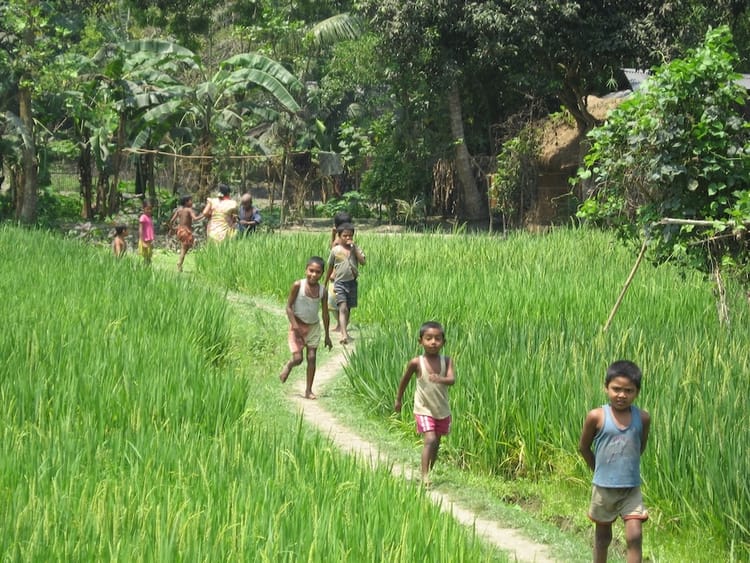
But my April 2009 visit to Netrokona was not just about Rokeya. I was already aware that Netrokona is one of the districts that sends a huge number of women to Dhaka and its nearby cities to work in RMG factories. So I began to inquire with Rokeya's brother, sister-in-law, and other relatives about women, migration, and factory work in Dhaka. I was amazed to find that from almost every house, an immediate family member or a relative had gone to work in a garment factory in Dhaka. I initiated a conversation with one mother whose daughter had gone to Gazipur to work in a factory. As I spoke to her, I came across a highly satisfied mother. She began to question me in detail about my own chakri (job). On hearing that I was a teacher, she remarked that the village also had school teachers – but the salary is poor. The remark was pointed – implying that my salary was no better than theirs. Then she asserted: 'My daughter earns good money. She does a good chakri – better than you.' She also informed me that her daughter was getting married to her co-worker soon and had saved her hard-earned money to finance her wedding. Then she turned her face away and said clearly:
'My daughter also looks much better than you do.'
I smiled and nodded positively.
A remote village, plenty of households of factory women, and a proud and happy mother. I thought to myself – I got my field!
Another Field, Another Day
After settling on Netrokona as my first sending village, I wanted to expand my horizon. For a time, I took the help of two research assistants to interview factory women from different places of origin. While going through their draft reports, I found that the respondents' places of origin were mostly from districts near Dhaka – Mymensingh, Tangail, Kishoregonj, and Gazipur topped the list. There were a few from Bogra, Sirajganj, and Rangpur in the north. But I found no respondent from Khulna or Jessore – the southwest part of the country. Also, earlier when I had talked to factory women in Tongi with my driver, no one was from Khulna. I was curious to know whether this was merely a coincidence.
I have a host of relatives in Khulna city. I talked to one of them, and what I heard was enough to decide my next field. My relative told me: 'The chances here are slim that you will find enough factory women from Khulna to Dhaka, because most of the young women here work in the shrimp and fisheries processing factories.'
I decided to embark on Khulna as my second field. I chose Khulna specifically because, whatever I had heard and experienced, it offered a relatively lower degree of Dhaka-bound migration. My interest in working in Khulna was also because it would allow me to see the impact of another form of globalization – the development of the shrimp industry – that acts as one of the retaining forces keeping its people tied to their home base.
Helping Hands I Never Knew I Had
I reached Khulna to identify sending villages – my first exploratory visit. One of my relatives assured me that he would help me in this process but also gently cautioned me not to expect much from Khulna. I felt a little depressed. However, rather than exclusively depending on him, I started to find out for myself. During the first few days, I began asking my relatives and anyone I met at family gatherings – sometimes even people I encountered on the roads – about Khulna's migration patterns.
In this process, I once asked my hotel room service attendant, Kaikobad, about his village, its livelihood pattern, and migration. Kaikobad echoed what I had been hearing from others – the number of women migrating from Khulna to Dhaka is usually very low. Young girls from solvent families attend school at least through class IX or X. Young girls from very poor families work in the shrimp processing factories. Early marriage is also an issue. But then Kaikobad told me that he knew two families from his village with daughters working in Dhaka factories and that he could help me contact them. If needed, he would accompany me to the village. I began to feel much better. His village was Khorshandya, under Dumuria Thana of Khulna District. He also told me of his neighboring village, Noakati, which also had a few sending families.
After hearing from Kaikobad, another room service attendant, Shariful came to me. Shariful was an overwhelmingly enthusiastic and ever-ready person with high energy to help in every possible way. He came back to my room several times a day to assure me of his help. The next day, he told me he had already talked to one of the families before coming to work and that I should meet them that very day. I felt Shariful's energy all day – several knocks at my hotel room door, phone calls, informal consultations with my husband and me about logistics. Then, to our surprise, he voluntarily took time off from work to take us to his village. I accepted his offer with all sorts of embarrassment. I began to think of it as a selfish act. But then I comforted myself with the thought that without his help it would have been really difficult to trace households through remote directions over a mobile phone, or to knock door to door in a village and talk to people. Getting access is a big challenge.
Shariful's village was Jughihaati, under Rupsha Upazila. Though the household survey and the bulk of the case studies were based on two adjacent villages – Khorshandya and Noakati – Jughihaati contributed a few in-depth interview participants, and as such became part of the heart of the research. Insights from all the villages visited also contributed significantly to mapping the overall migration pattern and conditions of Khulna as a whole.
Khulna is where my memory begins – my very first recollections of childhood are rooted there. It has always been a special place in my heart. The field research only deepened that bond. What surprised me most was not what I found in the data, but what life quietly placed in my path – a hotel room attendant named Kaikobad, an enthusiastic stranger named Shariful, respondents and family members I had never met and never expected to find. They became partners in this research journey without ever being asked to be. I had no words for their generosity then. I still do not.

The Ethical Weight of It
Feminist research deals with careful handling of ethical issues. The feminist movement and feminist research call for equality of treatment and opportunities. To me, conducting research with socially disadvantaged people, in some ways, limits the scope of practicing the inherent philosophy of that ethical stance. This is especially true in Bangladesh, which comprises an extremely unequal society with stark economic and social differences.
Many times during my field visits, I felt that I was taking advantage of my social position and intruding into the private space of my respondents and their families. I used to call the factory women at odd hours – after 10 pm – because they were not available to talk throughout the day. They had very tight work schedules from 8 am to late at night. They did not have fixed holidays during the peak season of production and shipment. Many of them were not even aware whether the next day would be a holiday. They would find out during the last working hour just before their day off. In all cases, I had to make several attempts to get a suitable time to talk to them. While calling them was not an issue in itself, pursuing them with several calls made me question my own principle of not encroaching into others' space beyond a certain point.
It took me five days to get an appointment with one respondent in Dhaka. It was not that I could not reach her – she was unsure of my intentions and took her time. One day I was exasperated. I told her that if she did not want to meet me, then so be it. I calmed down later and made the first move again. I tried to keep myself in her shoes and realized that such inhibitions were natural. Her family had already informed her about my visit to their place in Khulna, so she knew a little about my work. But she was not convinced as to why I had gone to Khulna and talked to her family. She termed it 'mysterious.' I had to call my local contact in Khulna and also her family to reassure her that my meeting with her would have no other intention or implication. Her cousin brother, settled in Dhaka, also called me. It was a kind of interrogation – and rightfully so. I had to explain everything from my job and my PhD work to my marital status and family. He was convinced. Finally, my respondent and I met and had a long talk.
When I visited respondents' natal family members in their villages, I felt embarrassed thinking of how much of their time and space I was taking. My local contact accompanied me, which helped me get easy access to households. But this also meant visiting houses at my convenience, not necessarily theirs. Their social position made it difficult for them to bluntly refuse to talk to a stranger from the city who was introduced by their local people. They were, to put it harshly, forced to give in to my choice, my own set of needs, and my preferred time frame.
In Noakati village in Khulna, one day we arrived at a household at around 2 pm – their lunchtime. I felt the family bore with my need, not because they were interested in sharing their story, but because they saw their local contact person accompanying me. In Netrokona, a woman of about forty-five was very hesitant to talk to me as her husband was away. She kept saying: 'He is not at home. I don't know what to say. God forbid, if I say anything wrong and end up in jail?' I assured her that if she did not want to talk to me, she did not have to. But before I could finish, my local contact retorted: 'If you land up in jail, what's wrong? No worry for food. You will have food free of cost.' Everyone laughed. Under that gentle peer pressure, the woman finally started to talk. I kept the conversation short to ease her doubts early.
This whole process of 'making' people talk to me was not something I would want done to myself.
I used to make it clear at the beginning of every conversation that the interview would serve my academic purpose and that the respondents or their communities were assisting me to write about them for people out there to read and understand their situation. However, there would not be any overnight change for the respondents or the community out of this work. Having said that, I could not fully justify my expectation of their wholehearted participation. I took it in my stride and began to think about what I would do if I were in their position. I had no pleasing answer.
Also, when hearing the respondents' stories, I let the interview flow go its own way. There were emotional ventilations, differences of opinion with family members, sometimes the story of a broken marriage, and traumatic experiences I was not prepared for. I gave a patient hearing. I showed compassion and empathy. But after a certain point, the emotion took over, and the interview lost its way. While this is only natural in feminist research, and perseverance is part of the job – I have to be honest. There were moments when my researcher's identity took the better of me. A few times, I gently cut short repeated emotional conversations and steered towards more focused ground. Due to time and availability pressures, it felt necessary in the moment. But it always left me feeling guilty.
They made time for my research. They opened up in ways they probably never had before – to someone who would not judge them. But could I always honor that trust? Were these women merely a check mark in my notebook? I completed my responsibilities as a researcher. But did I fully deliver on my responsibilities as a compassionate human being? I am still not sure.
Finally, measuring empowerment is problematic. There are many nuances in the way different people experience the same thing. The question that kept coming back to me throughout the fieldwork was: who am I to judge and comment on other people's experiences and empowerment by seeing their lives from above with a limited perspective? If feminist research advocates the notion of 'experience,' how far can I make their voices heard without experiencing what they are going through in their lives? I fear that while my work may contribute to existing scholarly research to some extent, it will not possibly gain wider ownership by the subjects themselves, to whom I am an outsider representing the privileged few.
Though research work has broader implications for knowledge production, primarily this work has individual interest, professional gain, and personal enrichment. This is not done out of any philanthropic philosophy. Hence I cannot escape my moral obligations – and I do not want to. Acknowledging them is the least I can do for the women who gave me their time and their trust.



Member discussion